The most important shift in AI right now isn’t a smarter model. It’s that you no longer have to be technical to put AI to real work. The tools have quietly crossed a line: you can now direct an AI agent, in plain English, to actually build things on your own computer, not just talk about them. The gap that’s left isn’t capability. It’s who has sat down and learned to use it.
Most leaders I talk to describe the same quiet frustration. AI is everywhere in their business: in the headlines, in the board deck, in three tools they’re already paying for. And yet, personally, they still can’t do much with it beyond asking a chatbot to tidy up an email. The technology feels enormous and just out of reach at the same time.
That feeling is backed by the data. 88% of organizations now use AI in at least one business function, up from 55% two years ago, but only 7% say they’ve actually scaled it. Adoption is nearly universal; real use is rare. And the value is not evenly distributed: McKinsey finds executives use AI roughly twice as often as their individual contributors, and Microsoft’s latest Work Trend Index reports 67% of leaders are familiar with AI agents versus just 40% of employees.
Read those two numbers together and the real story comes into focus. The bottleneck has moved. It’s no longer “can the technology do it?” It’s “have you learned to work with it?”
Chat talks. An agent acts.
Here’s the distinction that changes everything, in plain terms. A chatbot in a browser tab can only talk. It answers, drafts, and suggests, but you do all the actual work of copying, pasting, and assembling. An agent running on your own machine can act: it reads your files, runs the tools you already have, and produces finished things (a working spreadsheet model, a cleaned-up dataset, a small web page, a researched brief) while you direct it in ordinary language.
You don’t write code. You describe what you want, watch it work, and course-correct, the same way you’d brief a sharp new analyst. That’s the line the tools just crossed, and it’s why this moment is different from the last three years of “AI is coming.”
Why this matters most for the non-technical
The instinct is to assume agents are a developer’s tool. It’s exactly backwards. The people with the most to gain are the ones who were locked out of automation until now: the operator who lives in spreadsheets, the marketer drowning in campaign data, the executive who needs a question answered before a 9 a.m. meeting and doesn’t have an analyst free.
The payoff shows up on the most ordinary work. In a study of more than 7,000 employees across 66 companies, regular AI users cut about 31% (roughly 3.6 hours a week) off the time they spent on email alone. That’s not a moonshot. That’s a few hours back, every week, on work nobody enjoys.
And the wave is specifically agentic. Gartner expects 40% of enterprise applications to include task-specific AI agents by the end of 2026, up from less than 5% in 2025. The capability is arriving whether or not your team is ready to direct it.
The honest part
This isn’t magic, and we won’t pretend it is. Agents make mistakes, they need clear instructions, and they need a human who can tell good work from confident-looking nonsense. The skill that matters isn’t technical. It’s judgment: knowing what to ask for, how to check it, and when to push back. That’s a skill leaders already have. It just needs to be pointed at a new kind of tool.
Microsoft’s researchers put it well: closing the gap “will take more than access; it will require training, oversight, and a new way of working.” Handing everyone a license does nothing. Teaching people how to actually work alongside an agent is the whole game, and it’s exactly the kind of practical readiness we help organizations build.
So we wrote the on-ramp
Because the barrier is learning, not technology, we built a plain-language field guide to crossing that line yourself: The Build Manual. It walks anyone, no coding required, from “I have a chatbot” to “I have an agent on my machine building real things,” in about an afternoon, with a “go deeper” layer when you want it.
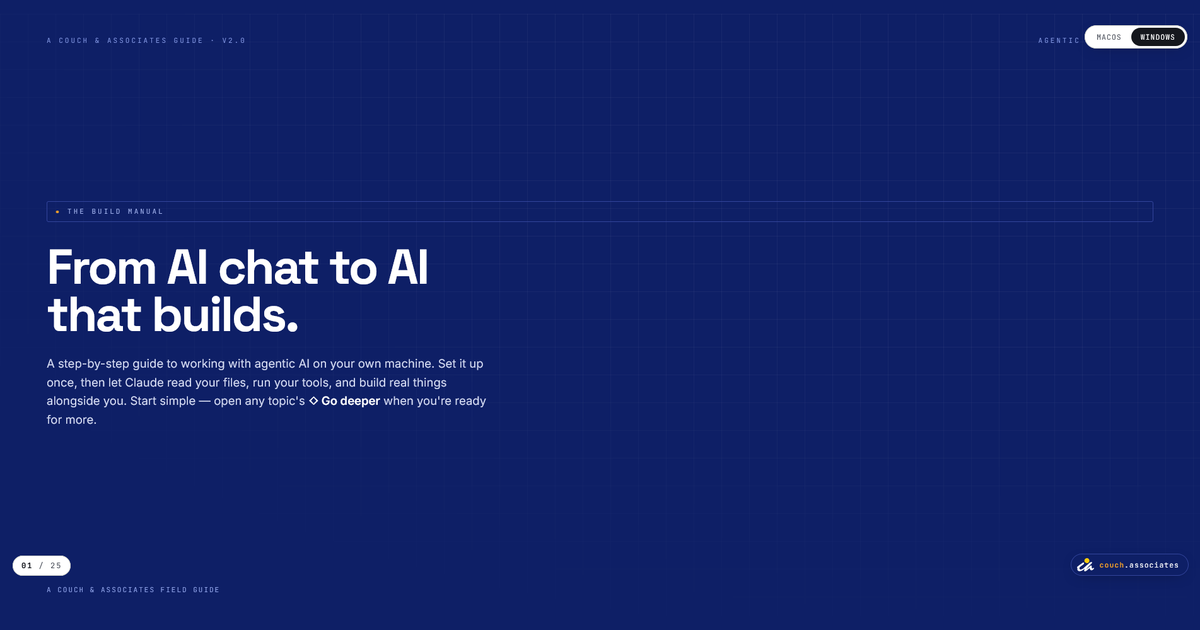
It’s deliberately for everyone. If you can write a clear email, you can follow it.
Frequently asked questions
No. You direct an agent in plain English: you describe what you want and review what it produces. The useful skill is clear thinking and good judgment, not programming.
A chatbot talks: it answers and drafts inside a chat window. An agent acts: running on your computer, it can read your files, use your existing tools, and produce finished work, with you directing and checking it.
It can be, with the right boundaries, which is exactly why judgment and oversight matter. Our guide covers the basic guardrails, and for anything involving sensitive data we recommend a deliberate readiness conversation before scaling it across a team.
With our free Build Manual, a step-by-step on-ramp written for non-technical people that takes about an afternoon.
The organizations that pull ahead won’t be the ones with the best models. Everyone has those. They’ll be the ones whose people actually know how to work with them. If you’re trying to turn AI from a line item into something your team genuinely uses, let’s talk. Helping organizations build that practical readiness is exactly what we do.
By Mike Couch, Couch & Associates. We help organizations move from AI curiosity to practical, everyday use: strategy, readiness, and hands-on implementation. Connect with our team.