Automated traffic passed human traffic in 2025, AI referrals convert several times better than search, and the largest share of AI-influenced visits still lands in “Direct”. Most of your buyers may still arrive the traditional way, and your lead-source, path and journey reports handle them fine. They were built for a browser and a cookie. What they cannot see is the growing share of buyers who arrive with an AI assistant having done the research first. On October 7 at noon ET we show what that lead looks like, using a real one, and how to see it in your own data. Save a seat here.
In early August a senior marketer at a mid-market company filled in a form on our site. Two pages, two minutes and fourteen seconds, done. Our analytics logged it as a branded Google click. Case closed: a walk-in.
Except they told us how they found us. They had asked an AI assistant to research consultants for the platform they run. So we went to the one record our analytics never touches, the web server log, and rebuilt the whole evening from it.
What actually happened
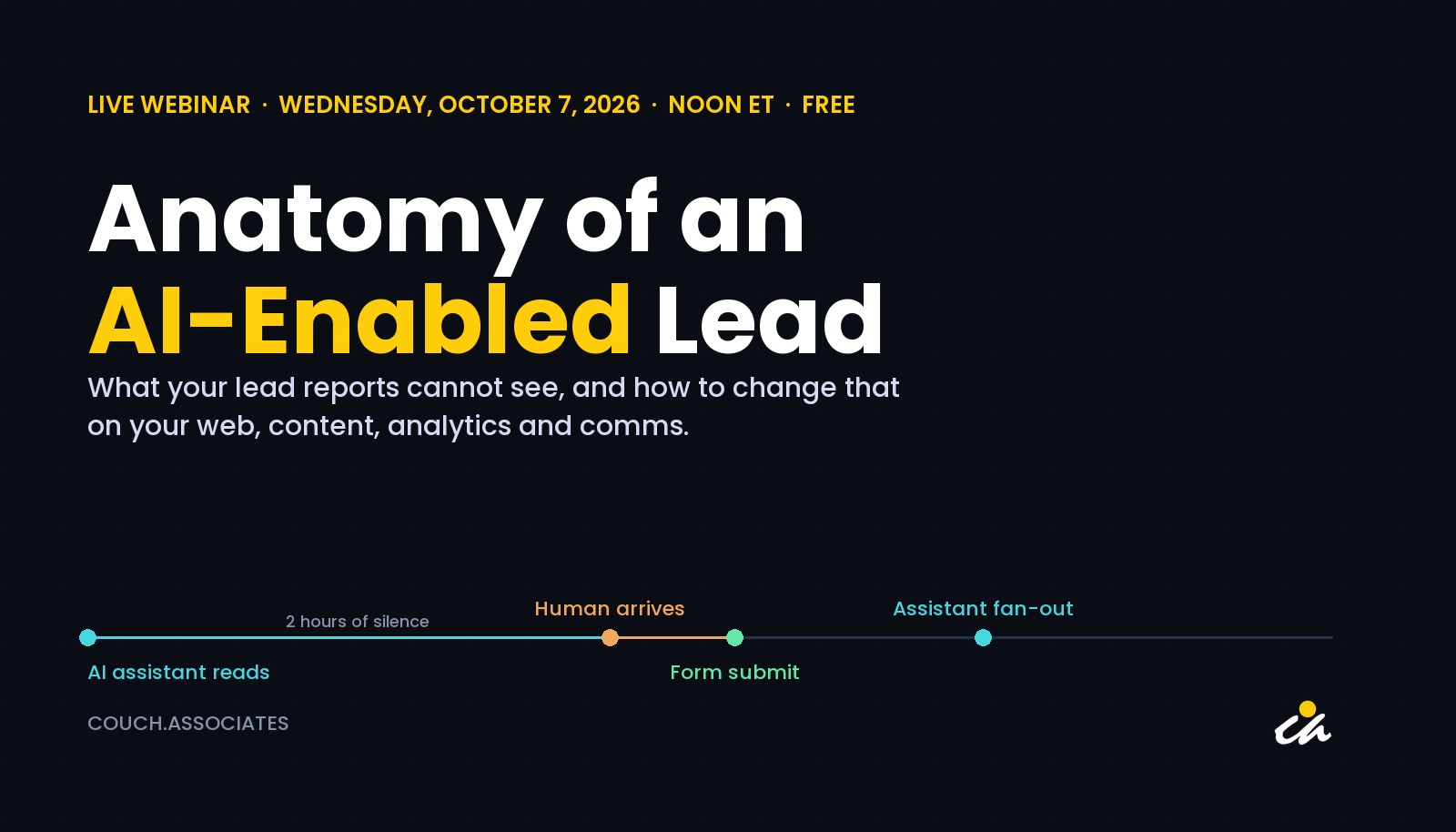
At 01:40 UTC an AI assistant, egressing from the vendor’s own cloud, fetched our homepage and the service page for their platform. Then nothing for two hours. At 03:38 the buyer arrived, from a residential connection, via a Google search for our name. While they were reading, the assistant fetched the same page again: they were cross-examining it about us. At 03:40 the form went in. Over the next three minutes the assistant read twelve more of our pages, the migration guide, the certified-experts page, an ask-the-experts edition, checking us out after the fact.
The assistant read twelve pages. The human read two. The decision was made before they ever saw our site, and the only thing Google contributed was a branded look-up at the end.
Old anatomy, new anatomy
| What the classic stack reported | What the server log showed |
|---|---|
| Source: organic search, branded query | Discovery: an AI assistant, two hours before the visit, verified by source address |
| Path: landing page, thank-you page | Deliberation: a two-hour silence, then a search for a name they already knew |
| Journey: first touch equals last touch, one visit | Cross-examination: the assistant re-read the page while they were on it, then fanned out across twelve pages after they converted |
| Engagement: no opens, no clicks, no nurture history | Conversion: 2 minutes 14 seconds, a decision already made |
| Verdict: a lucky walk-in | Verdict: a repeatable mechanism |
The classic report was not wrong. Every field in it was accurate for the two minutes it could see. It simply has no column for what happened before.
Why the stack cannot see this
Three reasons, and none of them is a configuration mistake.
Assistants do not run your JavaScript. Every tag-based analytics tool, GA4 included, sees the human’s browser and nothing else. The assistant’s reads exist only in the web server log, which most hosts keep for one to two weeks and most marketing teams have never opened.
The referrer is usually gone. Logged-in and app-based assistants strip it. Google added a native AI Assistant channel to GA4 in May 2026, which is welcome, but it only catches sessions that keep a referrer. Independent measurements put the referrer-less share of AI sessions somewhere between a third and two thirds, and those still land in Direct. If your Direct traffic grew this year and nobody can explain why, this is a good place to look.
Most “AI traffic” is not AI. The user-agent string is a client-supplied header, and attackers know it. In August, GreyNoise documented scanners across 824 addresses forging the names of thirteen AI crawlers to hunt for credential files. Our own logs showed the same: most requests wearing the assistant’s name came from the wrong cloud and asked for secrets, not pages. Any AI-traffic number that is not filtered on verified source address is counting attackers as buyers.
The numbers behind the argument
This is not one anecdote against the tide. Imperva’s 2026 Bad Bot Report puts automated traffic at 53% of all web traffic in 2025, with humans at 47% and falling, and names AI agents that “retrieve data, execute workflows, and act on behalf of users” as a new category of participant. Cloudflare’s breakdown of AI crawler traffic by purpose shows why the slice that matters is easy to miss: training crawls are nearly 80% of AI bot traffic, while “user action” fetches, the ones triggered by a person asking a question, are under 5%, and one assistant accounts for about three quarters of those. Small, distinct, and the only slice that turns into a lead.
On the search side, Seer Interactive’s 2026 study across 53 brands and 5.47 million queries found organic click-through on queries with an AI Overview fell to 1.31% in December 2025 against 3.16% without one, recovering only to 2.36% by February. SE Ranking’s analysis of 101,574 sites found AI referrals jumped 36.7% in a single month this spring, and that 60% of them land on the homepage rather than a deep page, which matches exactly what our assistant did. Whatever share of your buyers this is today, it is growing, and it arrives through a door most reports do not have.
One more of ours: the service page that assistant read sits on page four of Google for its category, with 2,309 impressions and zero clicks in the period. Every non-branded query we track for it earns nothing. Classic search was never going to deliver this buyer. Something else did, and it left a trail.
Three things to do before the session
Find out how long your server logs are kept. Ours are retained for about sixteen days. If yours are seven, you have a week to catch each lead’s real story. Ask your host today.
Locate your marketing-automation timestamps. Every form submit in Eloqua, Marketo, HubSpot or Pardot carries one. That timestamp is the key that joins the automation record to the server log to GA4 to Search Console. It is how we did it, and it is the whole method.
Read your own site as an assistant would. Is there an llms.txt? Structured data? More than one page an assistant could use to corroborate you on the topic you want to be recommended for? In our case the assistant read the homepage 37 times in two weeks and one thought-leadership article 19 times, more than every service page combined. Editorial is the magnet. Brochure copy is not.
What we will cover on October 7
A free, sixty-minute live session at noon Eastern: the buyer your reports were built for, and the one they cannot see; old anatomy against new anatomy on one real lead; the four-source reconstruction, shown as a timeline rather than a spreadsheet; signal versus noise and the verified-source rule; what the assistant actually reads on your site; a four-column rebuild checklist for web, content, analytics and comms; the KPI and the monthly report; and a two-minute live demonstration in which an AI assistant registers a colleague for the webinar itself. Anita Cordeiro joins me for the sales-side view of what these leads look like when they land.
Everyone who registers gets the recording and the checklist.
Or let your assistant do it. Our sign-up is agent-operable, so you can tell ChatGPT, Claude or Copilot to register you with your work email; we send you a one-click confirmation and you are in. That is not a gimmick. It is the thesis, demonstrated, and it is how our own site is built.
Frequently asked questions
A buyer whose research, shortlisting or decision was done with an AI assistant before they ever visited your site, so the visit itself is short, decided and usually attributed to Direct or a branded search. The assistant’s reads are visible only in your web server log.
Assistants do not run the JavaScript that tag-based analytics depend on, and many strip the referrer. GA4’s new AI Assistant channel helps with referred sessions, but sessions without a referrer still land in Direct and the assistant’s own page reads never appear at all.
They help, but the checklist covers changes you can make without them: content structure, machine readability, the marketing-automation timestamps you already have, and the GA4 settings that catch the referred share.
Yes to both. It runs at noon ET on Wednesday, October 7, 2026, for sixty minutes, and everyone who registers receives the recording and the takeaway checklist.
Marketing operations and demand leaders, analytics and RevOps owners, and CMOs who suspect their attribution has gone quiet for a reason. No technical background is needed.
Yes. The sign-up is exposed as an agent-operable service. Your assistant fetches the event, we email you a confirmation, and your click completes the registration. The event page explains how.
The lead was real, the journey was real, and the tools most teams trust could not see any of it. Your traditional buyers are still there and still measurable. The question is whether you can also see the ones who are not. Join us on October 7, or talk to us about where your own funnel may have gone dark.
By Mike Couch, Managing Partner, Couch & Associates. We help executives who know AI matters figure out where it will pay off, what could go wrong, and how to get from pilots to something that runs. Connect with our team.