See your market the way AI sees it.
Buyers now ask ChatGPT, Claude, Gemini, and Perplexity before they ever visit a website. QuadrantX reveals who those AI assistants recommend, who they position as the leader, and where your brand fits in the AI-driven buyer journey.
Built and operated by Couch & Associates, a 25-year B2B market intelligence consultancy.
Every vendor in a market, scored on two dimensions across 7 AI models. Leaders score 60+ on both.
The buying decision moved inside AI.
For thirty years the playbook was the same: a buyer has a problem, searches, visits a handful of websites, forms an opinion, decides. That journey is being re-routed inside AI conversations you cannot see. The brand that wins is no longer the one with the best landing page. It is the one AI puts on the shortlist when a buyer describes a problem in their own words.
The map, not the mirror.
Most AI visibility tools hold a mirror up to one brand: are you mentioned? QuadrantX maps the whole market.
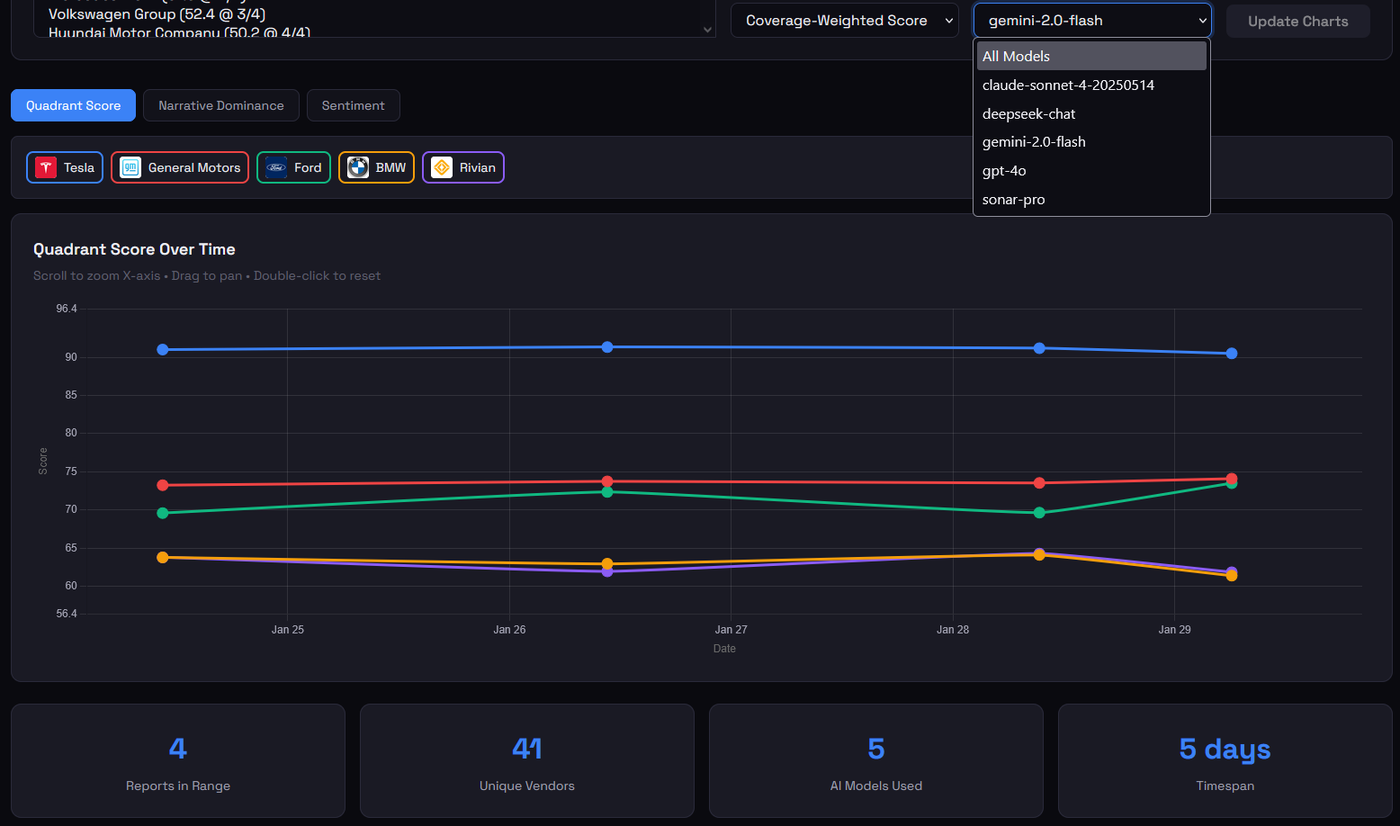
It queries the seven leading AI models with prompts written in real buyer language, such as “best marathon running shoes” or “CRM for a 200-person sales team.” Every vendor in the category is scored on two dimensions: Narrative Dominance, how prominently and consistently AI recommends a brand, and Sentiment, how favorably AI describes it. The result is a quadrant that shows leaders and laggards the way AI itself sees them, tracked continuously as models update and competitors move.
Category-level intelligence
Not just your brand. The entire competitive landscape in 119+ buyer-ask categories, so you can see who is winning the AI conversation and why.
Multi-model consensus
Seven models, multiple runs per question. Single-model bias and recency gaps cancel out. A statistical signal, not one model’s opinion on one day.
Continuous monitoring
Models change monthly and competitors keep moving. The value lives in the trend, and only continuous measurement captures it.
The story and vision behind QuadrantX
QuadrantX did not start as a product idea. It grew out of what we were seeing inside real client engagements: buyer behavior shifting into AI conversations faster than anyone was measuring. In this Q&A, Mike shares the thinking, perspective, and insights that led to its creation.

Co-founder, QuadrantX
What is your vision behind QuadrantX?
For thirty years the playbook was the same: a buyer has a problem, searches, visits a handful of sites, forms an opinion, decides. That journey is being re-routed inside AI. The decisive moment in a sale increasingly happens in a conversation you cannot see.
My vision for QuadrantX is simple to state: be the intelligence layer for that shift. Today, that means measuring who AI recommends in any market a buyer might ask about. Tomorrow, it means measuring who AI can actually do business with, because AI is becoming an agent that acts on a person’s behalf, not just a chatbot that answers questions. The companies that let agents discover them and transact with them will compound. QuadrantX exists so leaders can see that whole board clearly, and act on it.
What problem did you see emerging that led you to build this?
Two problems arrived at once. The first is invisibility. When a buyer asks ChatGPT, Claude, Gemini, or Perplexity for a solution, the model produces a confident shortlist, and most brands have no idea whether they are on it. You can lose a deal you never knew existed.
The second is measurement. The models frequently disagree with each other, and any one model’s answer changes month to month. A single screenshot of one chat is an anecdote, not intelligence. To manage this, brands needed an instrument: multiple models, many runs, consistent scoring, tracked over time. That instrument did not exist, so we built it.
“Most people are using AI in a completely inadequate way. The real opportunity is well beyond that.”
How did you identify this market opportunity before AI discoverability became a mainstream conversation?
We were not theorizing from the outside. Couch & Associates has spent 25 years advising B2B marketing and revenue leaders, so we sit exactly where changes in buyer behavior show up first. Starting in 2024, we built and used QuadrantX inside live client engagements, before this category had a name. When you watch real pipelines every day, you notice the research patterns shifting early, and you notice that nobody can answer the question “what does AI say about us?” with anything better than a guess.
The other advantage is that we build. We had already made our own website readable and operable by AI agents, and we watched AI crawlers become a meaningful share of traffic in server logs that standard analytics tools never showed. When your own data tells you the audience has changed, you stop debating whether the shift is real and start measuring it.
What trends or shifts did you see happening that others weren’t paying attention to?
Three, mainly. First, the misallocation. Most of the market points AI at cost reduction: automate the call center, write the emails, do more with less. It works, but cost has a floor. You can only cut to zero. The far bigger prize is revenue and market share, and the research now shows the value concentrating exactly there, in marketing and sales.
Second, agent-operability. An AI agent is the agent of a human. That is a principal-and-agent relationship as old as commerce, and the rails that let agents transact on a person’s behalf are already shipping from the biggest names in payments and infrastructure. Yet most companies still cannot accept something as simple as an agent completing an event registration. I would sit at major industry conferences realizing I could not send my agent to sign up for a session on my behalf. The infrastructure gap was that visible.
Third, the naysayer pattern. Every platform shift has loud skeptics right before the flip. People once said no one would ever buy a book on the internet. Then Amazon reshaped retail, and the skeptics became case studies. Resistance is not a reason to wait. Historically, it is the signal that the window is open.
“Cost reduction can only go so far. You can only cut to zero. The big opportunity is revenue and market share.”
What do you hope QuadrantX enables organizations to do differently?
Stop guessing. Without category-level intelligence, “improving our AI visibility” is an opinion. With it, you can see your whole market the way AI sees it, leaders and laggards alike, and every gap becomes a concrete piece of work: content, structure, agent readability, and eventually agent-operable transactions. Then the same instrument re-measures, so you know whether the work moved the number.
Just as important, I want leaders to reframe the question. Not “how do we do more with less,” but “where is the revenue we cannot see?” One example I use constantly: a professional association sells subscription access to a technical data library, and its members burn dozens of hours a year pulling from it by hand. Let an authenticated, paying agent fetch exactly what is needed in seconds and you have created a new premium tier. That is not cost savings. That is new revenue that did not exist before, governed and metered exactly the way human access is today.
Where do you see this space evolving over the next few years?
Every business is on a three-stage migration: human-only website, agent-readable, agent-operable. Marketing surfaces will go first because the risk is low: event signups, content access, promotions. Commerce follows, because the payment networks are already building for it. Your customer’s agent will discover you, evaluate you, and transact with you, and it will do it in any language, for a buyer anywhere in the world. A lot of the friction we accept as normal, including language and geography, simply dissolves.
Measurement has to evolve with it. The question moves from “who does AI recommend?” to “who can AI do business with?” and QuadrantX is built to measure both. I compare this moment to the web itself: we went from almost nobody having a website to everybody having one in roughly ten to fifteen years. This shift is moving faster, and the winners will be the leaders who treated it as a revenue strategy rather than an IT project.
“This is the same scale of change as when nobody had a website to when everybody had a website. And it is happening faster.”
From who AI recommends to who AI can do business with.
Every business is somewhere on this migration. QuadrantX is built to measure all three stages, today and as the market matures.
Human-only website
Built for human browsing. Agents have to guess what matters, so the brand is misread or left off AI shortlists entirely.
Agent-readable
Structured content and machine-readable surfaces. Agents can find and understand you. This is where AEO and GEO live.
Agent-operable
Permissioned actions and governed transactions. Agents can do business with you on a buyer’s behalf.
Monitoring is step one. Acting on it is where we come in.
QuadrantX is the same monitoring layer Couch & Associates uses inside client engagements. When the scorecard surfaces a gap, we can help you close it.
Get agent-ready
We make websites discoverable, readable, and operable by AI agents, and we took our own site to a perfect 100 agent-readiness score. Every engagement includes 6 months of QuadrantX, free, so you can watch the work pay off.
Explore the serviceRun the scan yourself
QuadrantX offers a free site scan that grades your website’s AI readiness in seconds, plus public category reports you can explore before you ever talk to us.
Try the free scanStart with a conversation.
No pitch deck. No predetermined answer. A 30-minute call to understand where your brand stands in the AI conversation today, and what to do about it.
Submissions go to Mike Couch and Anita Cordeiro. We respond within one business day. We never share your details with third parties.