A considered purchase used to mean a car, a mortgage, or an enterprise software contract: anything worth days of research. AI assistants have made that research free, so the same extended search, spec comparison, and shortlisting now happens for a $40 kitchen thermometer. The buyer still makes an emotional final choice. The difference is that an agent built the list they chose from, and most marketing is not yet built for that.
A century of sorting purchases into two piles
Marketing theory has always drawn a line between purchases that get thought about and purchases that just happen. Melvin Copeland drew the first version in the Harvard Business Review in 1923: convenience goods bought with minimal effort, shopping goods the customer compares before buying, and specialty goods worth a special trip. John Howard’s 1963 model, formalized with Jagdish Sheth in The Theory of Buyer Behavior (1969), named the two ends extensive problem solving and routinized response behaviour. Herbert Krugman’s 1965 paper on television advertising added the idea of low involvement: brands that win without the buyer ever really paying attention. Henry Assael’s four buying types and Richard Vaughn’s FCB grid (1980) turned that into the planning tools an entire generation of agencies used: high involvement and thinking on one side, low involvement and feeling on the other.
The trade term “considered purchase” grew out of that literature as agency shorthand for the top-left quadrant: expensive, infrequent, risky, and researched. Everything else was habit or impulse, which Dennis Rook defined in 1987 as “a sudden, powerful urge to act that arises without conscious deliberation.”
The most useful finding in the whole tradition is one that rarely makes it into a marketing deck. In 1990, John Hauser and Birger Wernerfelt showed that the size of a buyer’s consideration set is a trade-off between the cost of evaluating one more option and the benefit of doing so. Even in coffee and deodorant, the measured sets were three to four brands. The line between a considered purchase and a trivial one was never really about the product. It was about the cost of the research. Nobody spent an evening comparing kitchen thermometers because an evening was worth more than the thermometer.
The journey models kept redrawing the map
The models of how buyers move from need to purchase changed more often than the two-pile theory did. AIDA, usually attributed to E. St. Elmo Lewis around 1898 (the attribution is contested), became the sales funnel when William Townsend drew it in Bond Salesmanship in 1924. McKinsey replaced the funnel with the consumer decision journey in 2009, with an initial consideration set that expands as well as shrinks during evaluation. Google’s Zero Moment of Truth (2011) described the research phase that now precedes the shelf, explicitly including “corn flakes.” Google’s messy middle research (2020) mapped the loop between exploring and evaluating, and showed in 310,000 simulated purchases that a fictional brand loaded with six cognitive biases beat an established one 87 percent of the time.
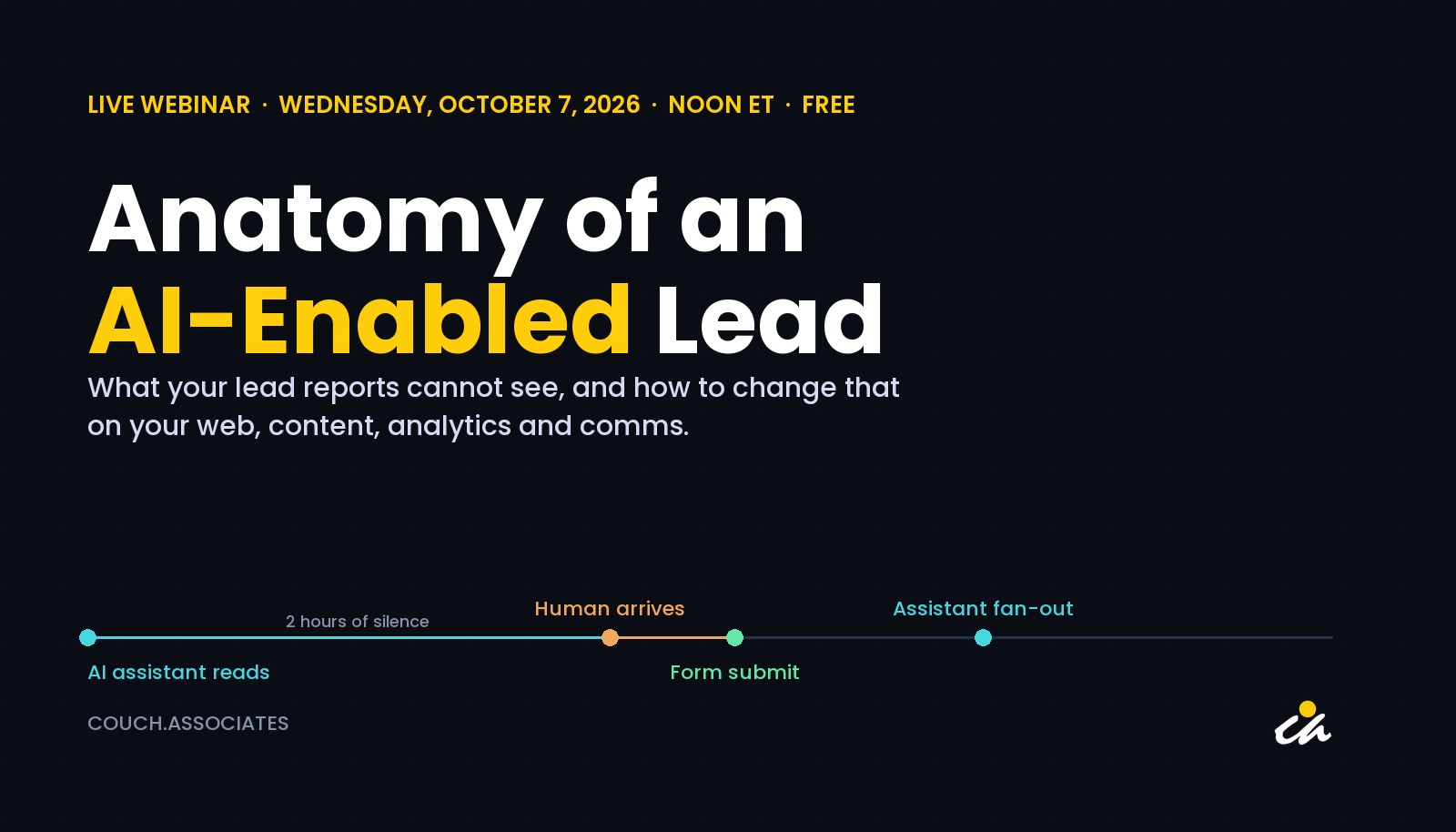
On the B2B side the story ran ahead. Gartner’s buying-jobs research found 77 percent of buyers rated their last purchase very complex, and that buying groups spend only about 17 percent of the process with any supplier at all. By the time 6sense surveyed 4,000 buyers in 2025, 94 percent of buying groups had ranked a preferred vendor before first contact, and that vendor won 77 percent of the time. The considered purchase, in B2B, had become a research project that ends before the seller knows it started. Our own reconstruction of one such purchase, in Anatomy of an AI-Enabled Lead, found the assistant’s research trail two hours before the human ever arrived.
What changed in 2025: the cost of research went to zero
The two-pile theory assumed that research is expensive. In the last eighteen months that assumption broke. OpenAI shipped shopping research in ChatGPT in November 2025, which turns a one-sentence brief into a buyer’s guide with top products and the differences between them. Google added conversational shopping and agentic checkout to AI Mode the same month, then published the Universal Commerce Protocol with Shopify, Target, Walmart, Visa and Mastercard in January 2026. Amazon’s shopping assistant, now Alexa for Shopping, serves hundreds of millions of customers and will buy from other retailers on their behalf. Shopify turned agentic storefronts on by default for every merchant in March 2026.
The behaviour followed the tools. Adobe Analytics, which measures more than a trillion visits to US retail sites, saw traffic referred by generative AI rise 693 percent year over year across the 2025 holidays, concentrated in video games, toys, appliances, electronics, and personal care. Those are not cars and mortgages. More telling is what happened to conversion: AI-referred visitors converted 38 percent worse than everyone else in March 2025 and 54 percent better by May 2026. People arriving from an assistant have already done the considering. Salesforce put the aggregate at $262 billion of online holiday sales influenced by AI and agents, one dollar in five. Bain found 30 to 45 percent of US consumers already using generative AI for product research and comparison, and expects spec-driven household essentials to go agentic first.
The decision is still emotional, and that is the point
The thesis is not that buying has become rational. The research suggests the opposite: the rational part has been delegated, which leaves the human free to be emotional about the pick. Chiara Longoni and Luca Cian showed in the Journal of Marketing (2022) that people prefer an AI recommender for utilitarian attributes and a human for hedonic ones. The agent does the snow shovel; the person chooses the scarf. Antonio Damasio’s patients who had lost their emotional signals could compare options indefinitely without ever choosing, which is a fair description of a product page with 4,000 reviews. Sheena Iyengar and Mark Lepper’s jam study found that six choices sold and twenty-four did not, a result later meta-analyses narrowed to specific conditions, unfamiliar categories among them, which is exactly where a shortlist helps most.
The 2026 consumer surveys draw the same line in the same place. Gartner found that 31 percent of consumers will let AI narrow their choices for household supplies and 28 percent for electronics, but only 11 percent will let it make the decision, even in low-stakes categories. Accenture’s survey of 25,590 consumers found 74 percent would trust a personal agent more than their best friend to carry out a purchase, 56 percent would hand it a list of brands to consider, and 9 percent would let it act with full autonomy. Bain found people trust a retailer’s own assistant three times more than a third-party one. Capgemini’s 2026 consumer study concluded that quality, trust, and emotional connection now matter more than price alone. The shortlist is analytical. The choice from it is still a feeling.
B2B and B2C are meeting in the middle
For thirty years B2B and consumer marketing ran on different models because the buyers behaved differently. That is ending from both directions. Business buyers now behave like consumers: Gartner’s 2026 survey found 67 percent prefer a rep-free experience and 45 percent used AI in a recent purchase; Forrester notes that 64 percent of business buyers at manager level or above are now Millennials or Gen Z, bringing consumer expectations with them. TrustRadius’s 2026 study of 1,862 buyers found 63 percent used AI in the buying process, 94 percent fact-check what it tells them, and 83 percent shortlisted three or fewer products.
Consumers, meanwhile, now behave like business buyers: extended search, spec comparison, a shortlist of three, and a human validation step, applied to categories the textbooks filed under habit. The number is the same on both sides. Three or four options, chosen by someone or something else, and then a person decides. Hauser and Wernerfelt’s consideration set has not changed size in 36 years. What changed is who builds it, and how far down the price list the building goes.
What this means for marketers
If every purchase gets the considered-purchase treatment, then every marketer inherits the B2B marketer’s problem: the decision is largely made before you know the buyer exists. Six changes follow.
- Be legible to the agent. Adobe’s readability checker found retail home pages about 75 percent readable by AI models and product pages 66 percent. Cloudflare’s scan of 200,000 domains found 4 percent declare any AI preference at all. Structured product data, plain-text specifications, and schema are now the difference between being in the shortlist and being invisible. Our agent-readiness work starts here.
- Earn the shortlist by frequency, not rank. SparkToro and Gumshoe ran 2,961 shopping prompts and found identical lists fewer than one time in a hundred, yet the leading brands appeared in 55 to 77 percent of answers. There is no position one to hold. There is a share of appearances to grow, which is what QuadrantX measures.
- Feed the sources the agent actually reads. An analysis of 3,312 product prompts found the assistants citing YouTube, Reddit, and independent review sites far more than brand domains. Reviews, comparisons, and third-party corroboration are now the raw material of the shortlist. TrustRadius found 74 percent of buyers relying on user reviews, and transparent pricing the top request for the fourth year running.
- Make specs and prices explicit. Agents compare what they can parse. A product whose dishwasher rating is in a PDF loses to one whose rating is in a table. Bain’s finding that spec-driven categories go agentic first is a warning to every category that thinks it sells on feel alone.
- Be operable as well as readable. The Agentic Commerce Protocol, the Universal Commerce Protocol, Copilot Checkout, and Shopify’s default-on storefronts mean the agent can now complete the purchase, register for the event, or request the quote. A site an agent can read but not act on is the new “ranking first with a broken buy button.” We build that layer on top of existing marketing stacks, and run it on this site.
- Fix the measurement, because the research is invisible. One attribution study found 70 percent of AI-assistant visits arriving with no referrer, filed under Direct, and converting at four times the rate of the rest. GA4 added an AI Assistant channel in May 2026, forward-only and referrer-dependent. If your reports cannot see the considered part of the purchase, they will keep telling you the buyer was impulsive.
The final pick stays human, which means brand, trust, and the emotional signal the agent cannot compute matter more, not less. The work is to be in the three, and then to be the one.
Where to go from here
On October 7 we walk through a real AI-enabled lead from the server log up, including the two hours of assistant research your lead-source report cannot see, and the web, content, analytics, and comms changes that make it visible. Save a seat for the webinar. If you would rather start with your own site, the AI Readiness Assessment takes a week, costs nothing, and shows how the assistants shortlist your category today.
Save a seat for the October 7 webinar
Frequently asked questions
A purchase the buyer researches and compares before deciding, historically because it was expensive, infrequent, or risky: cars, appliances, insurance, enterprise software. The opposite is a habitual or impulse purchase made without deliberation.
Because the cost of research has fallen to almost nothing. AI assistants such as ChatGPT shopping research, Google AI Mode, and Amazon’s shopping assistant compare specifications, prices, and reviews in seconds, so the extended search once reserved for big purchases now happens for everyday ones.
Rarely. Gartner’s 2026 consumer survey found about 31 percent of consumers will let AI narrow their choices but only 11 percent will let it decide, even in low-stakes categories. People delegate the analysis and keep the emotional final choice.
It is getting shorter and more self-directed. Gartner found 67 percent of B2B buyers prefer a rep-free experience and 45 percent used AI in a recent purchase; 6sense found 94 percent of buying groups had a preferred vendor before first contact.
Make product and service information machine-readable, earn presence across many AI answers rather than one ranking, feed the review and comparison sources agents cite, publish explicit specs and prices, make the site operable by agents, and fix analytics so AI-assisted visits are no longer filed under Direct.
Couch & Associates advises on, builds, and manages the marketing technology, AI, and cloud behind revenue, for companies whose customers research before they buy. See how we work.